
.jpeg)

Pro Gear Advisers
•866-498-7882
ARC STUDIO+: IK Multimedia Goes Fully Digital on Room Correction
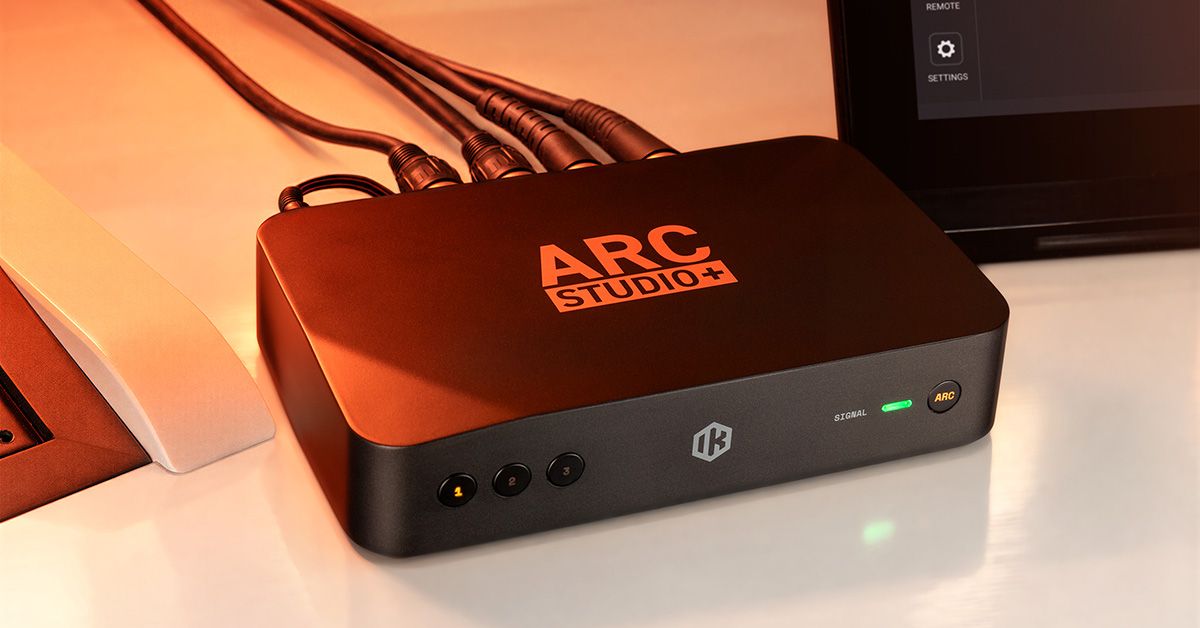

There's a particular kind of self-deception every home studio owner eventually has to confront: the mix that sounds glorious at 2 a.m. on your nearfields and falls apart the second you play it in the car.
It's not your ears lying to you—it's your room.
Standing waves, boundary reflections, the trihedral corner where your low end goes to die—your listening space is coloring everything you hear, and no amount of expensive speaker upgrades will fix a problem that's architectural.
IK Multimedia's answer to that problem is ARC—Advanced Room Correction—and on October 15, the ecosystem's hardware flagship got a successor: the ARC STUDIO+ I sat down with Ryan Roth, product marketing manager for Studio & Pro Audio at IK Multimedia, to talk through where the STUDIO+ fits and what it actually adds.
Short version: The big story is the addition of expanded I/O. Digital ins and outs, plus a dedicated sub output, turn the Plus into something closer to a fully digital monitoring chain than a stereo-only analog box. The rest of the ecosystem—the case for hardware correction at all, and how IK's headphone modeling works—is worth understanding first, because it's the frame the Plus is being built into.

Table of Contents
Why Hardware, Not Just a Plug-in?
ARC has existed as a plug-in for years, and Roth's case for the hardware box comes down to eliminating variables—a phrase that came up more than once. A software correction plug-in runs on your host CPU and has to be inserted correctly in every DAW session. This creates a very real failure mode: forgetting to bypass it before you bounce stems and printing your room's flaws into a mix that's about to leave the house. The hardware unit sits inline between your interface's main monitor outputs and your speakers, correcting the final analog signal system-wide and independent of any DAW—set it and forget it, with no plug-in to remember to disable. Because the correction happens after the signal leaves your computer, it also applies to whatever's coming out of a browser tab or a media player, not just your session.
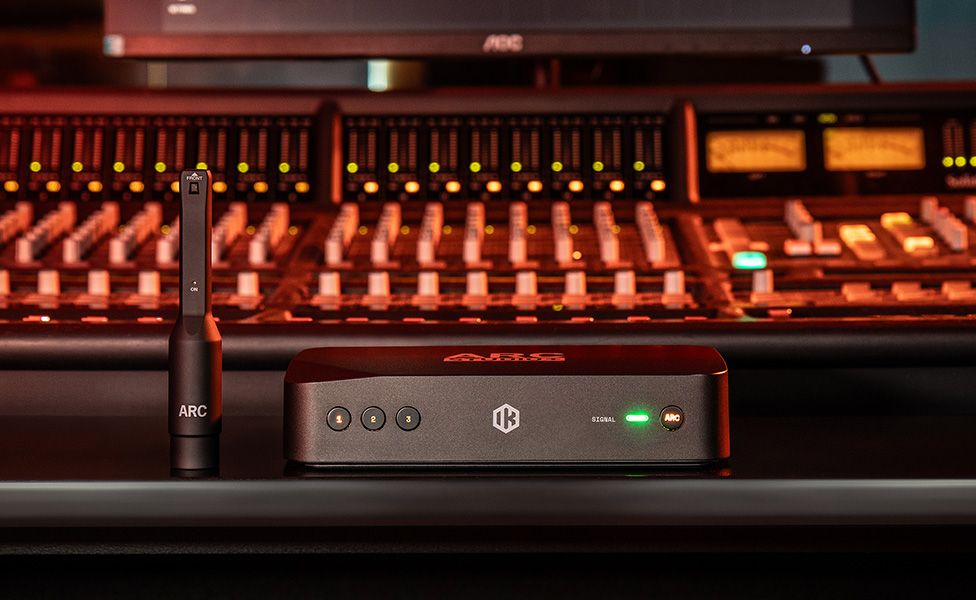
What's New in the ARC STUDIO+ ?
ARC STUDIO+ is the successor to the original ARC Studio, and the case for it starts with the signal path. Roth said IK kept hearing from users running interfaces like the Universal Audio Apollo—gear with optical outputs—who wanted a fully digital chain end to end, cutting both latency and the signal degradation that comes from repeated AD/DA conversion.
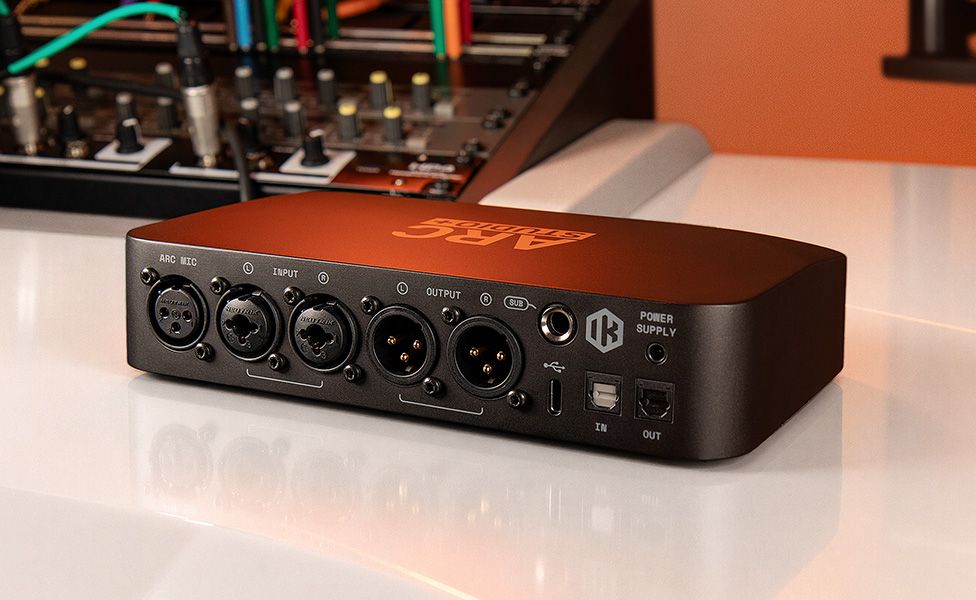
That's the Plus's reason for existing: digital I/O—USB-C and optical S/PDIF on the input side, optical S/PDIF out—alongside balanced XLR/TRS analog in and balanced XLR analog out, so a digital-native studio can stay digital all the way to the speakers without giving up analog compatibility.
In addition to that headlining feature, the STUDIO+ adds:
-
A dedicated sub output with automatic subwoofer management: The unit detects when a sub is connected, handles phase and level alignment between the sub and mains, and manages crossover point and slope internally, rather than leaving that to a separate processor.
-
Three onboard presets: Each stores a full configuration: calibration profile, speaker routing, sub on/off and input selection—recallable from the front panel or through the software.
-
Standalone one-touch calibration: Connect the included measurement mic to the rear-panel input, hold the front-panel button and the unit performs a single-point capture with no computer or interface involved. Multi-point measurement (1/3/7/21 positions) remains available through IK's ARC X software for permanent rooms wanting a wider sweet spot.
-
Relay-controlled hard bypass: When bypassed, the audio path is electrically isolated from the processor rather than just muted in software.
Pay particular attention to that second bullet point. As Roth pointed out, "You don't need an interface to calibrate with this. So, there's a lot of excitement around it." This brings the ARC STUDIO+ to a completely new level of usefulness for studios that may not be centered around a DAW or even around a computer.
ARC Studio and ARC STUDIO+ will be sold alongside each other at different price points rather than one replacing the other. The original will stay in the line, positioned for immersive and multi-channel setups. Roth frames the original as the option for someone who doesn't yet need the Plus's digital I/O or independent sub calibration—not quite "beginner," in his words, but someone without the appetite for that level of routing control. The Plus is pitched at users pushing a home setup toward something closer to a project studio: more control, more options, for people who've already hit the ceiling of what a stereo-only, analog-only box can do for them.
ARC STUDIO+ lands at $399 with the ARC measurement microphone or in a $349 configuration without the mic. It ships in an all-aluminum enclosure, a redesign shared with the refreshed original ARC Studio. The STUDIO+ offers 32-bit conversion up to 192kHz, 120dB(A) dynamic range and roughly 1.4 ms latency (natural-phase mode). The latency spec is the equivalent of sitting an additional 18" further way from your speakers.
It's worth noting how much of the STUDIO +'s feature list traces directly back to user feedback and wish list items that have been circulating around the original ARC Studio since it launched—digital I/O chief among them, but also the desire for independent sub calibration and a way to calibrate without an external interface in the chain.
Roth framed that responsiveness as core to how IK operates rather than something specific to this launch: "We did have a lot of people saying, ‘Hey, I'm using an Apollo. It's got optical out. I would love to just do a full digital. It'll cut down on my latency, it'll cut down on my AD/DA conversion stuff. I want it to be a pure signal path.’ That's why we developed this as well. We're always trying to be as customer-centric as possible. We listen to the customer." The Plus reads less like a from-scratch redesign and more like IK working through a punch list assembled from its own users and the people who reviewed the original box.
The Other Half of the Ecosystem
The STUDIO+ handles speakers. The other half of ARC—headphones—runs through a companion device, the ARC ON-EAR, which models more than 50 headphone types. rather than measuring your specific pair.
“We want to provide the best possible experience out of the box for the user so that there aren't any issues, right?, said Roth. “So, for example, you know, with our ARC STUDIO+, we have the included MEMS mic. That's a proprietary mic, plus or minus 1dB in variance—very accurate. And we would not really recommend using a third-party mic for that example. We like everything to sort of be proprietary because it's tested, it's trusted, it's ready to go.”
That proprietary system is designed specifically to keep user error out of the equation—a bad measurement from an untrained user or a cheap third-party mic produces a bad calibration, and a bad calibration produces a support ticket.

Headphones that aren't in the database can be requested through IK's site, and the list grows monthly. “there's a link on our website that you can put in the headphone request and we'll try to get to it as soon as we can to add it," said Roth.
As a test case, Roth provided an example. “I pulled up your Fostex T60 RPs and I'm looking at them right now,” he said. “It shows their pre-curve. So it looks like the curve has about a 4dB boost at about 1kHz. Then there's a dip around 3kHz, and then there's a solid boost of 6-7dB around 10kHz. And so that's something that your ears are probably very, very familiar with. So, you know, it may take some adjustment once you calibrate them to sort of recalibrate your ears for every mixing decision that you do.”.
The Case for Correction Over New Gear
Roth's broader pitch—worth taking seriously whether or not you buy IK's hardware—is that acoustic treatment and speaker upgrades solve different problems, and most home-studio owners are solving the wrong one first.
“I think there's a lot of maybe a challenge where people have their room and it's untreated and they're just like, ‘You know what? I'm gonna buy new speakers 'cause that'll fix my problem,’” said Roth.
He continues, “Why don't you try calibrating your current speakers and you can get the most out of your speakers with that, with ARC. When it comes to the headphones, you probably don't need new headphones. Just buy an ARC ON-EAR, see how you like it.
“It may fix a lot of the issues you've been having. So, I do think that the ARC product family itself obviously isn't a perfect band-aid for everything, but it will get you closer to sounding like a professional. It will get you a step closer.”
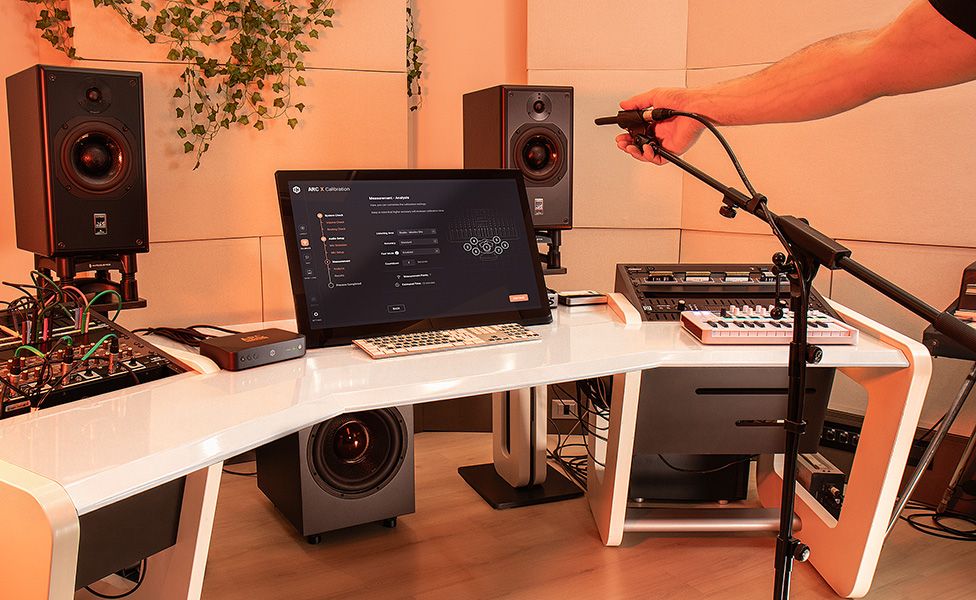
The reason is that a better pair of monitors in an untreated room still hits the same standing waves and boundary reflections, merely making the distortion higher-fidelity. Room correction addresses the room itself, and it's a more cost-effective first move than chasing gear. Basic DIY treatment—fabric-wrapped panels, bass traps in the trihedral corners where low end piles up—still belongs in the chain too; ARC STUDIO+ alone isn't a replacement for physical treatment, more a way of correcting what treatment alone can't reach in a small room.
As Roth pointed out, "You get easier access to better sound. You don't need new speakers. You don't need new headphones. Try it with what you got. Trust your ears."
While we talked, we discovered that we were both “coffee geeks,” and realized that there was a principle embodied in making a great cup of coffee that applies to audio engineering and studio design and many other areas of life. Change only one variable at a time when you're chasing a solution to a problem. In coffee, you don't change the grind, the water temperature and the brewing time all at once. You tweak them one at a time until you get the result you want. It's the same with room correction and mixing. You make one small change and see whether that brings you closer to the sound you want to hear.
All of this circles back to why the ARC STUDIO+’s I/O and other new features matter more than they might look on a spec sheet. It's not a new correction algorithm—it's IK removing the last analog conversion stage between a digital source and a calibrated listening position, for the segment of users who were already routing everything else digitally and felt the ARC Studio's analog-only I/O as the odd step out. And it's an easier, faster way to set up your system for mixes that will translate well to the widest range of real-world listening environments.
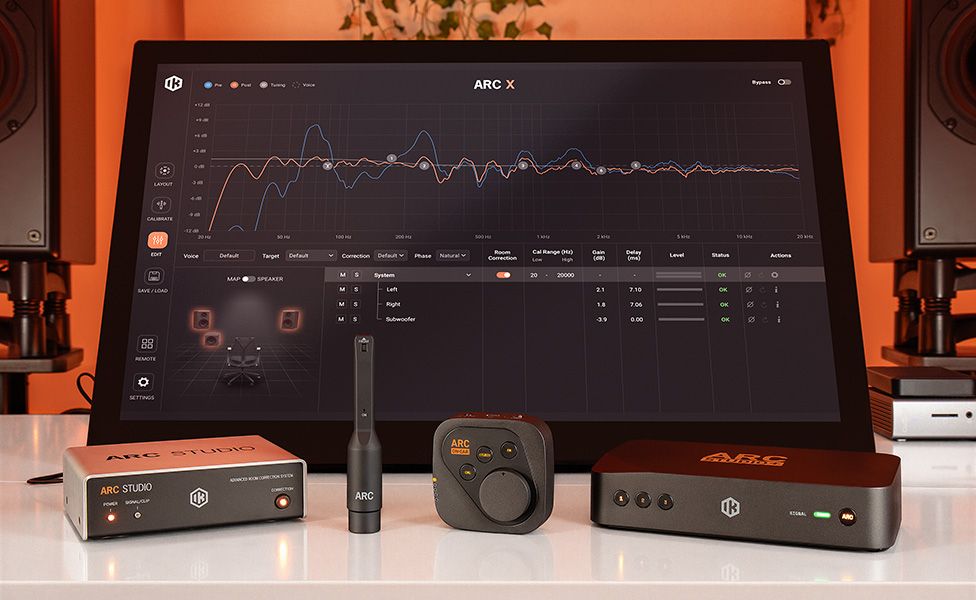
Pictured: IK Multimedia ARC Studio, ARC ON-EAR DAC/Headphone Amp and ARC STUDIO+
Conclusion
As a long-time user of the original plug-in version of ARC, I have to admit that the ARC STUDIO+ is aimed directly at players and engineers like me. It solves a lot of problems that can be a struggle for anybody who's trying to get the best sound out of a small home studio.
The ARC STUDIO+ enables you to get consistent mix results that will be listened to on playback systems ranging from headphones and earbuds to Bluetooth and car speakers, to more sophisticated home theater setups. All of this is accomplished with a simpler set when you need to bounce stems or a full mix out of your production system, enabling you to focus on the music and the sound.
Call your personal Gear Adviser for assistance, I'm probably going to be the next guy on the line.
Written By: George Van Wagner
George Van Wagner is a writer and editor for Guitar Center, where he has worked since 2007. A multi-instrumentalist, freelance recording engineer, arranger, composer, writer and all-around tech geek, he has over 30 years of experience in the musical instrument industry at companies like Midiman/M-Audio and Line 6, doing everything from customer service and writing user manuals to working in product development. He is currently gigging around Los Angeles with Gruppo Subconscious and Bobby “Hurricane” Spencer.

Be the first to know about exclusive offers, tips and more.

866-498-7882 English
877-687-5402 Español