

Pro Gear Advisers
•866-498-7882
The History of the Fender Telecaster | Origins, Timeline & Key Models
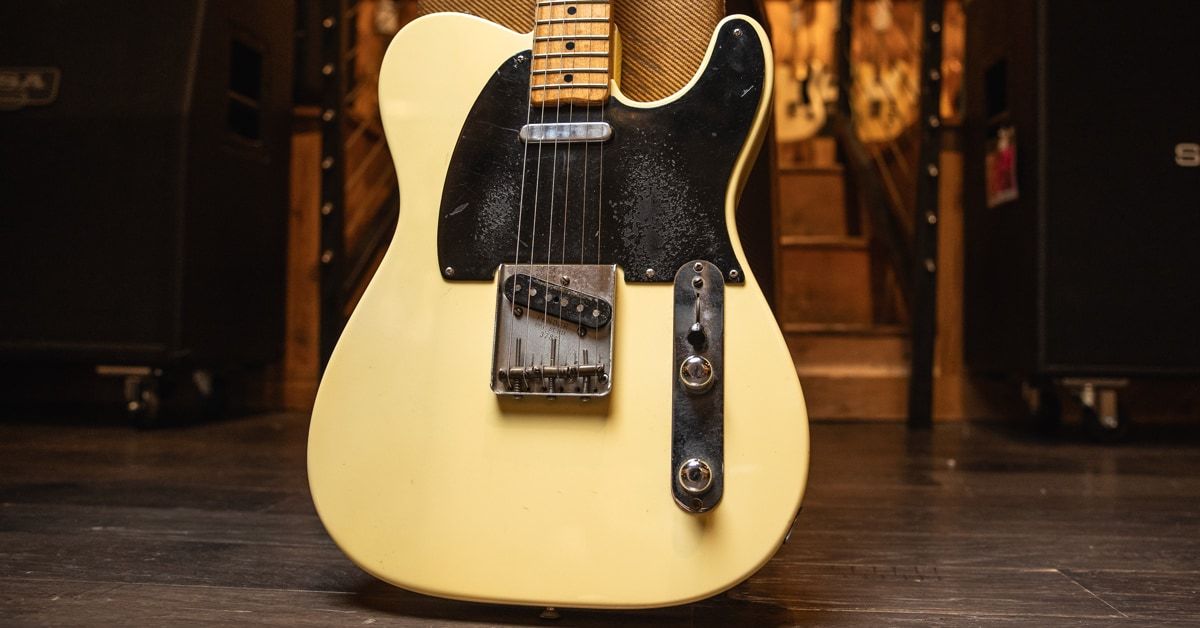

The Fender Telecaster is the essence of what an electric guitar is, stripped down to only the essentials—wood, strings, pickups and basic controls. Going by the philosophical principle known as Occam's Razor, which states that the simplest explanation for anything is the one that is most likely to be true, we're reasonably sure that if William of Occam were around today, he'd be playing a Fender Telecaster. Sometimes, simple wins.
In this article, we’ll walk through an overall history of the Telecaster, provide a concise timeline of the Telecaster’s evolution, and connect key historical milestones with modern Fender models that reflect those design eras. And because the Tele’s story isn’t just written in specs and wiring diagrams, we’re also including a curated list of nine essential tracks—spanning country, rock, jazz, metal and beyond—that showcase just how expressive and genre-defining this so-called “simple” guitar can be.
Table of Contents
Early Fender Telecaster History
Leo Fender famously never played a guitar, or any other musical instrument, though he loved music. So, how did he come to create not one, not two or even three, but at least half a dozen (and we're not stopping to count, but it's more than that) of the most iconic electric guitars and basses on the face of the planet? Fender's journey from a radio repair shop in Fullerton to a world-spanning manufacturer is one of the greatest examples of how an enquiring mind, the ability to listen to the ideas of others and a serious work ethic can combine to change the world. Let's take a quick look at how the Telecaster came to be.
The Birth of the Telecaster
First things first, let’s dispose of one piece of misinformation that’s out there about the Telecaster. Many believe the Telecaster was first released in 1948, though some have even claimed it to be as early as 1946. This is largely because, under the ownership of CBS (and more about this a little later), the Fender marketing department had made those claims in various ads and press releases. In actual fact, the Esquire and Telecaster (then called the Broadcaster), which are essentially the same guitar with a difference in pickup arrangement, debuted at the NAMM show at the beginning of 1950. Part of the confusion may also be that, starting in 1946, Leo Fender filed several patents for various elements of what would become the Tele.
One other thing to mention: While both Les Paul and Paul Bigsby had previously built solidbody electric guitars, they were essentially handmade one-offs. Fender, following his philosophy that if something is easy to service, it’s easy to build, was the one who created the first production solidbody electric guitar.
1946 was also the year Leo bought out Clayton “Doc” Kaufman—a musician and fellow tinkerer, with whom he had founded K&F Manufacturing in 1945—and started the Fender Electric Instrument Company. Fender’s 1946 patent on the string-thru-coil, “horseshoe” magnetic pickup also shows the pickup on a solidbody instrument that, although it looked somewhat like a lap steel, had a rounded neck for playing “Spanish style.” A second patent, this one for the bridge/pickup combination, was filed in 1948, showing it on a single-cutaway body that bears a striking resemblance to the guitars that were to come.
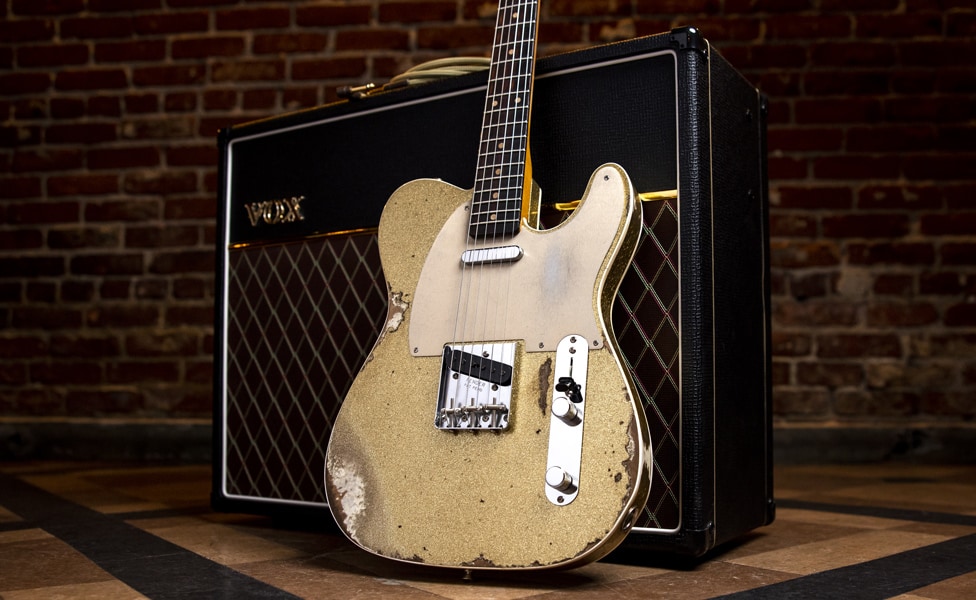
Fender’s success with steel guitars and amplifiers, combined with his tendency to listen carefully to feedback from players, led him to develop tight ties with the West Coast country and Western swing communities. And what he had been hearing from guitarists was that they wanted an instrument that wouldn’t feedback easily and would cut through the sound of a sizable band in the same way Fender’s steel guitars did. With the patents filed and the basic concepts pulled together, prototypes began to appear in 1949—this means the Tele was invented approximately somewhere between 1948 and ’49.
There are two other names we need to bring into the story here: George Fullerton and Don Randall. Fullerton, a machinist and electronics hobbyist with a flair for drawing, had joined the young company in 1948, and is credited with refining the body designs. Randall, who was working for Francis Hall (who would go on to purchase Rickenbacker Guitars) as a salesperson for Hall’s distribution company, RTEC, had convinced Hall to distribute Fender’s amplifiers and steel guitars. A natural sales and marketing type, Randall had become quite involved with Fender and was responsible for naming quite a few of Fender’s early products. And, speaking of names …
The Name Game
When the instrument that would become the Fender Telecaster debuted at the 1950 NAMM show in Chicago, that name lay in the future. The guitar shown was the single-pickup Esquire, while the two-pickup model, which Don Randall had dubbed the Broadcaster, would debut later that year. But there was a problem.
When the Broadcaster debuted in late 1950, Fender shortly afterward received a communication from Fred Gretsch requesting that they cease using the name, as Gretsch had been making a drum set named “Broadkaster” since the 1920s. Fender quickly pulled the name and the ever-frugal Leo Fender simply clipped “Broadcaster” from the supply of decals and continued using them with the Fender logo, but no model name. These guitars, which were produced for less than a year, have become known as the “Nocaster,” though that has never been any sort of official name. Nocaster is simply the colloquial term for those early Fender Telecaster models in which Broadcaster was removed from the headstock.
In the meantime, Don Randall, who had been reflecting on radio and its importance to music when he named the guitar “Broadcaster,” was looking at the booming growth of television. In a similar vein to the first name of the guitar, he decided a reference to TV was called for and proposed the name “Telecaster.”
So, in less than a year, we had one guitar with three names—rather two names and one not-name. But what were the differences, if any, between the Broadcaster vs. Telecaster and later models? For that, let’s look at some (not-overly) technical specs.
Timeline of Telecaster History
1950–1951: Broadcaster becomes Telecaster
- 1950: Leo Fender releases the Broadcaster—a two-pickup version of the earlier Esquire
- 1951: Renamed Telecaster after a naming conflict with Gretsch’s “Broadkaster” drums.
- Shop Similar Models: American Vintage II 1951 Telecaster draws directly from this origin.
Early 1950s: Esquire and early Tele adoption
-
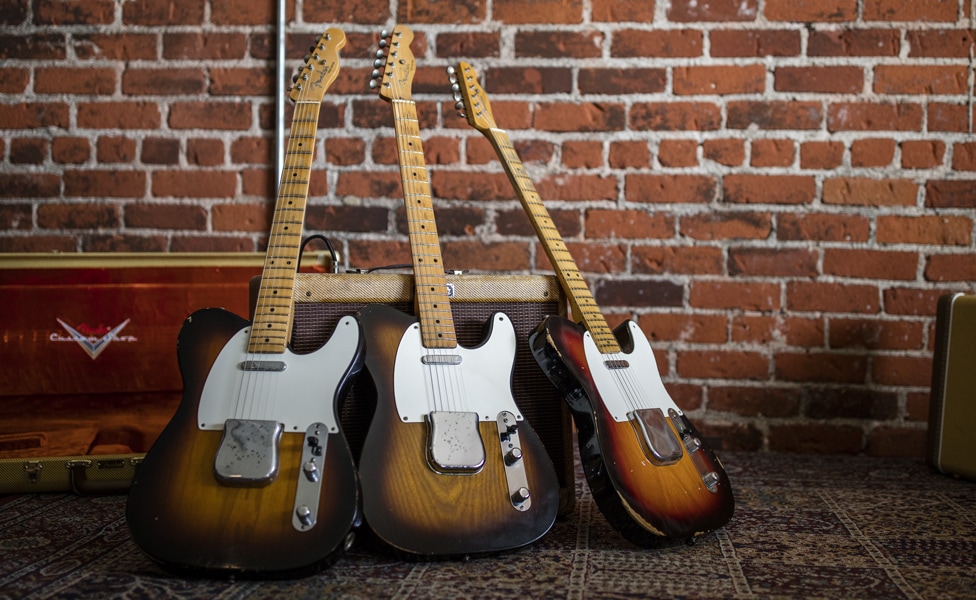
1950–’54: The Esquire (single-pickup model) remains in production as a more affordable option.
Mid-1950s: Blackguard Telecaster Era ends
- Transition from Butterscotch Blondes and black pickguards (“Blackguard Teles”) to more subdued looks.
- Shop Similar Models: Custom Shop Time Machine Series often recreates specific early ‘50s Blackguard models.
1959: Slab rosewood fretboards introduced
- Fender begins offering rosewood fingerboards on Teles to appeal to jazz players.
- Shop Similar Models: American Vintage II 1963 Telecaster showcases this shift.
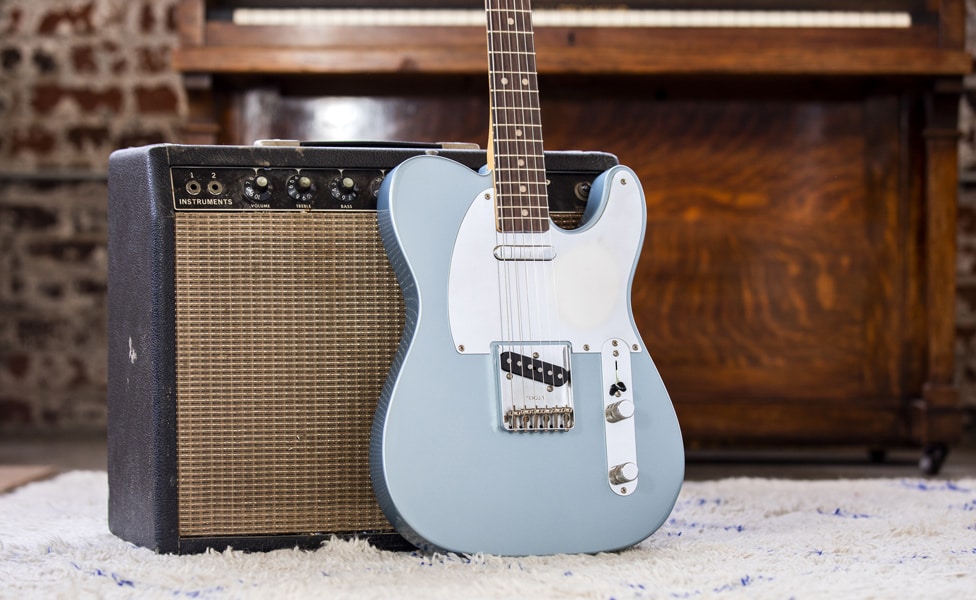
1968–1972: Paisley and Thinline models appear
- 1968: Introduction of the Pink Paisley and Blue Floral finishes.
- 1969: First Thinline Telecaster, with semi-hollowbody and f-hole.
- Shop Similar Models: American Professional II Telecaster Thinline Limited-Edition represents this style.
- 1972: Launch of the Thinline Telecaster with Wide Range humbuckers.
- Shop Similar Models: American Vintage II 1975 Telecaster Deluxe mirrors this configuration.
1980s: Reissues and rebranding
- Fender revives vintage-correct models under the American Vintage banner.
- Custom Telecasters, Deluxe and Thinline get nostalgic attention.
- Shop Similar Models: Vintera Series and American Vintage II Series stem from this reissue spirit.
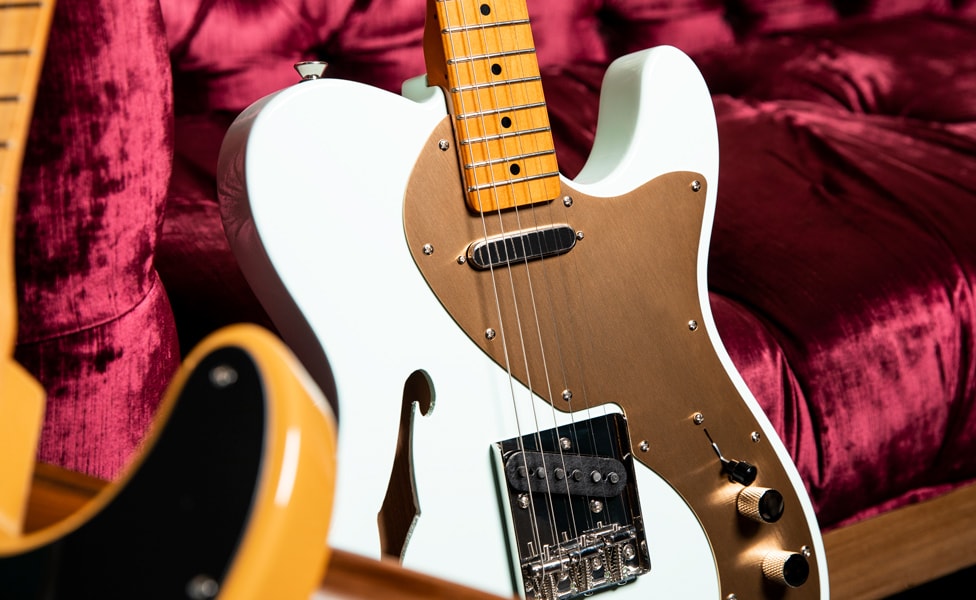
1990s–2000s: Expansion of signature and modern variations
- Rise of hot-rodded and genre-specific Teles (e.g., HH or HSS pickup configurations).
- Signature Teles for artists such as Jim Root, Richie Kotzen and Brent Mason broaden tonal range and aesthetics.
- Shop Similar Models: Jim Root Telecaster, Brent Mason Telecaster, John Osborne Telecaster, Mike Campbell Red Dog, Jimmy Page "Dragon" Telecaster
2020s: Ultra Luxe Vintage, Player II, American Ultra II and hybrid modern-vintage lines
- Vintage aesthetics with modern feel, electronics and finishes.
- American Ultra Luxe series introduced with sporty neck carves, noiseless pickups and compound radii.
- American Ultra II series showcases the most advanced Telecaster design evolution.
- Shop Similar Models: Ultra Luxe Vintage Telecaster, American Professional II Telecaster, Player II Telecaster and American Ultra II Telecaster represent cutting-edge Tele development.
Modern Telecaster Models Inspired by Key Eras
The Telecaster’s iconic silhouette hasn’t changed much since 1951, but current Fender models certainly reflect different eras of its evolution, from vintage-inspired for the traditionalist to fully enhanced for the shred-oriented player. Here’s how today’s most popular Telecaster series compare.
|
Model |
Era Inspiration & Tone Profile |
Best For … |
Approx. Price |
|
’50s with contemporary tweaks; open, twangy and articulate |
Country, blues, rock, indie |
$ |
|
|
’50s with contemporary tweaks; traditional with an aggressive edge |
Country, blues, rock, pop, indie, hard rock |
$ |
|
|
Late ’50s, Early-Mid ’60s; chimey, steely, twangy and bright |
Country, blues, rock, soul, jazz |
$$ |
|
|
Early ’60s; warm, chimey and punchy |
Country, blues, rock, indie, soul, jazz |
$$ |
|
|
2000s–2020s; balanced, crisp and clear |
Country, blues, rock, pop, indie, soul, jazz |
$$ |
|
|
’50s–’70s; versatile across the series, from single-coil snap to humbucking snarl |
Country, blues, rock, pop, indie, hard rock, soul, jazz |
$$$ |
|
|
’50s and ’60s with contemporary tweaks; golden-era Tele tone that’s bright, dynamic and articulate |
Country, blues, rock, pop, indie, hard rock, soul, jazz |
$$$ |
|
|
2020s; versatile voicing, from crystalline cleans to full, mean gain |
Country, blues, rock, pop, indie, hard rock, soul, jazz, metal |
$$$ |
Essential Tracks That Show What a Telecaster Can Do
Buck Owens—"Act Naturally" (1963)
If there’s a single track that defines the clean, biting twang of a Telecaster in the country idiom, it’s this one. Don Rich—Buck Owens’ right-hand man—played a Telecaster with razor precision, helping craft what would come to be known as the Bakersfield Sound. On “Act Naturally,” his bright, articulate tone cuts cleanly through the mix, trading Nashville polish for something leaner and more electric. It’s not just about clarity—it’s about attitude, and the Tele delivers it in spades. The song became so synonymous with the style that even the Beatles later covered it, with Ringo Starr on vocals—proof that Rich’s Tele tone didn’t just define a genre; it crossed oceans.
The Rolling Stones—"Can't You Hear Me Knocking" (1971)
While Mick Taylor’s soaring, Latin blues solo tends to steal the spotlight, it’s Keith Richards’ rhythm playing that lays the foundation. Using his “Micawber” Telecaster—tuned to open G and modded with a humbucker in the neck—Richards crafts a slinky, hypnotic groove that’s part riff, part percussive engine. It’s a masterclass in comping: understated, essential and pure Telecaster attitude.
Bruce Springsteen—"Born to Run" (1975)
Springsteen’s Tele isn’t a textbook vintage—it’s a Frankenstein blend of a ’50s Esquire body with a Telecaster neck—but the tone is unmistakably Fender. The guitar’s snappy mids and high-end chime drive the entire rhythm arrangement, cutting through the Wall of Sound mix without needing distortion or excess volume. It’s equal parts grit and uplift, just like the song itself. Every rake, strum and accent from The Boss feels direct, urgent and physical—pure Tele energy translated into anthemic rock.
Roy Buchanan—"The Messiah Will Come Again" (1976)
Few players ever got as emotionally raw with a Telecaster as Roy Buchanan. On this track, the Tele becomes a voice—wailing, whispering, howling through its dynamic range. His use of volume swells, fingerpicking and subtle vibrato showcases not only the guitar’s range but its sensitivity to nuance. It’s an unvarnished performance, captured through an equally unforgiving signal chain. The result: proof that the Telecaster is as much about expression as it is about tone.
The Pretenders—"Brass in Pocket" (1979)
Chrissie Hynde’s rhythm guitar on this Pretenders classic is a study in feel. The Telecaster’s crisp top end and lean midrange let her comp and slash with just enough percussive edge to carry the track. There’s no overdrive to hide behind—just confident playing and rock-solid timing. It’s the kind of Tele tone that sounds simple until you try to replicate it—and then realize it lives entirely in the player’s hands.
Radiohead—"Just" (1995)
Jonny Greenwood’s jagged, articulate tone on “Just” is a showcase of a Telecaster’s clarity under pressure. His parts are angular and borderline chaotic, yet they retain definition in a dense mix. The Tele’s high-end bite and quick response let Greenwood punch through Radiohead’s swirling guitar layers without relying on saturated gain. It’s a different kind of aggression—sharp, clean and urgent—proving a Telecaster doesn’t need to scream to command attention.
Slipknot—"My Plague" (2001)
Slipknot guitarist Jim Root’s signature Fender Telecaster rewrites the rulebook on what a Tele can be. With active EMG humbuckers and stripped-back aesthetics, his take on the instrument is built for clarity at crushing volumes. On “My Plague,” it’s the Tele’s inherent stability and string separation that let his down-tuned riffs breathe. There’s no mud—just tightly focused attack, rapid-fire palm mutes and harmonic squeals that never smear. It’s a metal machine, but still a Tele at heart: unshakably honest, unapologetically direct.
Julian Lage—"Persian Rug" (Live in Los Angeles) (Recorded 2019, released 2021)
Played through a wide-panel Tweed Princeton miked with a Royer R-121, Lage’s Tele tone here is about as naked as it gets. “Persian Rug” leans into harmonic depth and touch sensitivity—the kind of playing where every slight variation in pick attack and finger pressure reads loud and clear. At one point, Lage reaches for a blistering diminished run and flubs it slightly, grinning through the mistake as Scott Colley and Kenny Wollesen catch it in stride. It’s a perfect Tele moment: unfiltered, vulnerable and totally alive.
Everybody Needs a Tele
Considering that entire books—some of them doorstoppers—have been written about the Telecaster’s history and influence, we’ve barely scratched the surface here. And we haven’t even touched on every Tele model you can buy today or dug into what to look for when shopping vintage—for that, “How to Buy a Vintage Fender Telecaster” can help.
Speaking of Tele models, the best way to find out what’s right for you is to check out our companion article, “A Guide to the Fender Telecaster,” then stop by your local Guitar Center, speak with one of our knowledgeable Associates and play a few to find the exactly correct match.
Or, you can chat with the equally knowledgeable Associates at our Call Center to track down your Telecaster. Of course, you can browse to your heart’s content on our website and see everything that’s available, all in the comfort of your home (or office—it’s okay, we won’t tell your boss). Whatever way you choose to shop, a Telecaster is a guitar that belongs in everybody’s collection. It’s that simple.
Written By: George Van Wagner
George Van Wagner is a writer and editor for Guitar Center, where he has worked since 2007. A multi-instrumentalist, freelance recording engineer, arranger, composer, writer and all-around tech geek, he has over 30 years of experience in the musical instrument industry at companies like Midiman/M-Audio and Line 6, doing everything from customer service and writing user manuals to working in product development. He is currently gigging around Los Angeles with Gruppo Subconscious and Bobby “Hurricane” Spencer.
Recently Added to Gear Tips
Be the first to know about exclusive offers, tips and more.

866-498-7882 English
877-687-5402 Español