.jpeg)

Pro Gear Advisers
•866-498-7882
The Best Distortion Pedals of 2026
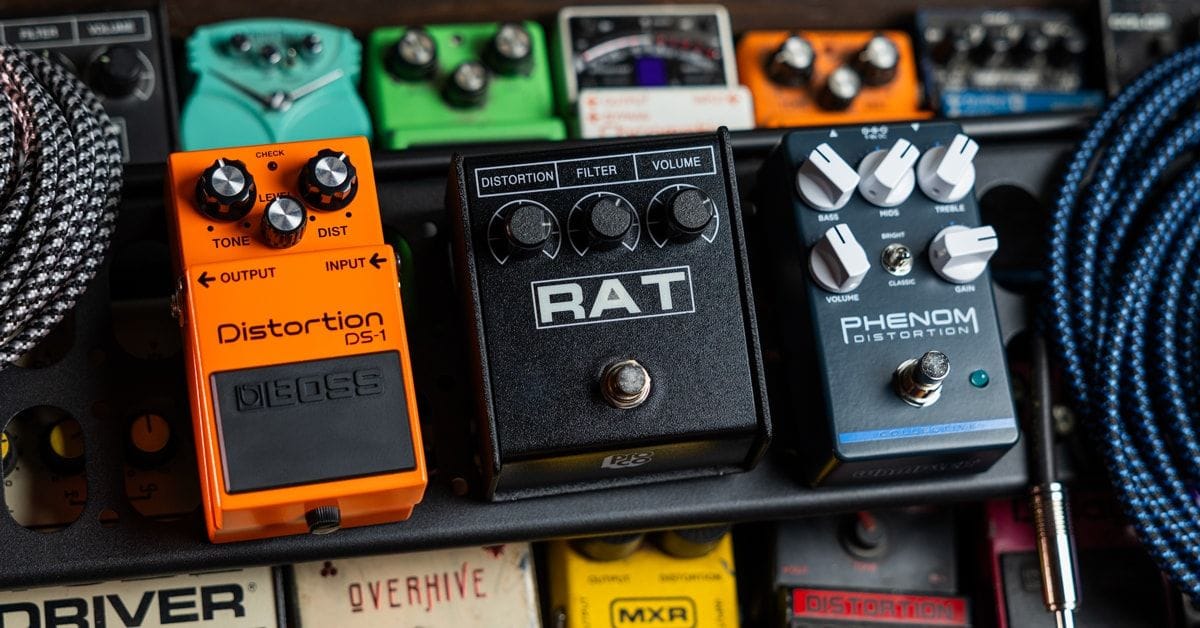

Distortion is one of the most essential and satisfying sounds at a guitar player’s disposal, capable of transforming a generic clean tone with complex, harmonically rich saturation for scorching rhythms and sizzling leads. It takes an existing signal and applies hard clipping, adding second- and third-order harmonics that result in an immediately distinguishable sound integral to the electric guitar itself. The best distortion pedals fundamentally offer higher gain than an overdrive and a more controllable, articulate style of saturation than fuzz, establishing a baseline sound for a wide variety of genres.
Whether you’re tricking out a clean, pedal-platform amp with a whole suite of effects, or adding another gain stage in front of your favorite dirty amplifier, distortion pedals supply all the firepower you need to take your sound to the next level.
If you want to learn more about the origins and evolution of distortion, check out The History of the Distortion Pedal.
Table of Contents
Comparing the Top Distortion Pedals
The Best Distortion Pedals
Get Down and Dirty With a New Distortion Pedal
Comparing the Top Distortion Pedals
|
Distortion Pedal |
Tonal Characteristics |
Power Draw |
|
Crunch that can be bright and cutting, or rounded and mellow |
9V, 10mA |
|
|
Extreme high gain with focused midrange and exceptional clarity |
9V, 35mA |
|
|
Upper-harmonic enrichment to full on roar |
9V, 15mA |
|
|
Versatile overdriven, fuzzy or medium-high-gain distortion that’s dynamic and responsive |
9V–18V, 10mA |
|
|
“Buzzing” high-gain sound associated with early Swedish death metal |
9V, 140mA |
|
|
High-gain distortion with active EQ for shaping low-end and top-end response |
9V DC, 80mA |
|
|
Everything from bright, saturated leads to thick, crushing low mids |
9V, 88mA |
|
|
Cutting, punchy fuzz-distortion that remains articulate under gain |
9V, 100mA max. |
|
|
Dense, biting saturation with exceptional clarity and articulation |
9V, 15mA |
|
|
No-nonsense overdriven crunch and fuzz-like distortion |
9V, 2.5mA |
|
|
Tight and gritty, with gain on tap for overdrive, distortion and fuzz |
9V, 1.6mA |
|
|
Smooth, robust, tube-like distortion with responsive dynamics |
9V–18V, 5mA |
The Best Distortion Pedals
BOSS DS-1
What to Know:
-
An iconic distortion pedal used by countless rock legends since 1978
-
Primarily voiced for gritty rock tones, but also works well as a boost at lower distortion settings
-
Runs on a 9V battery or 9V DC power supply (sold separately)
Shop Now: BOSS DS-1 Distortion Pedal
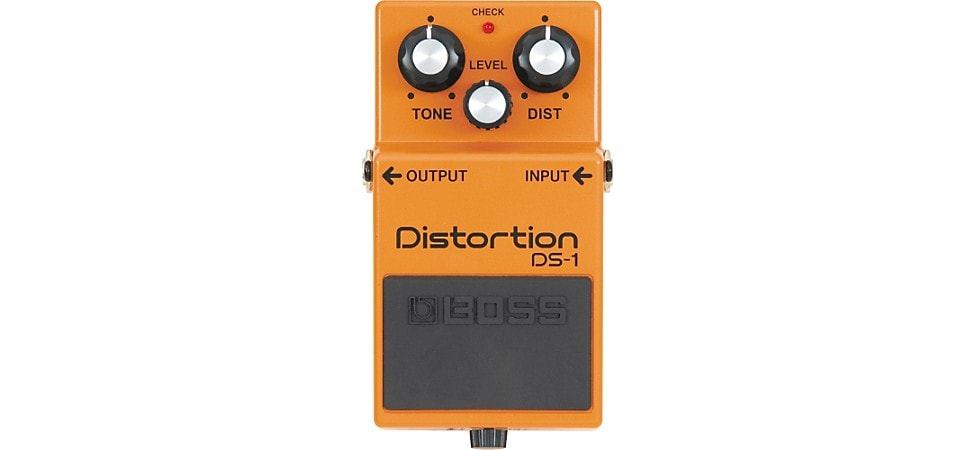
In an age where most gain pedals were of the fuzz flavor, the BOSS DS-1 Distortion blew doors down with a tight, assertive style of hard clipping, and was an influential piece of the tonal puzzle for the burgeoning punk, hard rock and metal scenes of the era. Steve Vai, Joe Satriani, Prince, John Frusciante and Kurt Cobain are a handful of notable DS-1 players, each managing to pull their own unique tone from the little orange box.
The BOSS DS-1 is capable of mildly driving an amplifier at lower gain settings or tearing it to shreds with vicious rock distortion. Its famous tilt EQ simultaneously boosts highs and cuts lows as you turn it up, while moving counterclockwise does the opposite. Tones range from sharp and biting to full-bodied and warm, and this distortion pedal does a stellar job of keeping the actual sound of your guitar and pickups intact. BOSS also offers a Made in Japan version, the DS-1W, which offers an additional "Custom" mode that provides even fatter distortion and enhanced touch sensitivity.
BOSS MT-2W Metal Zone
What to Know:
-
Captures the extreme high-gain sound of the ’90s with Waza Craft refinement for contemporary metal
-
Its markedly mid-focused voice brings clarity and definition to punishing riffs
-
Runs on a 9V battery or 9V DC power supply (sold separately)
Shop Now: BOSS MT-2W Waza Craft Distortion Pedal
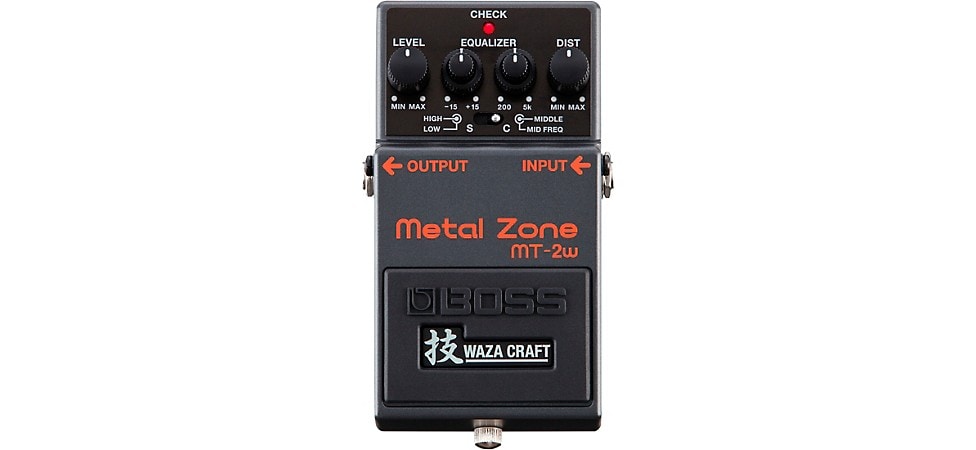
Introduced in 1991, the original MT-2 offered savage saturation with a laser-focused midrange and 3-band parametric EQ. The BOSS MT-2W Waza Craft builds on a legacy started over 30 years ago, retaining the distortion pedal’s infamous sonic signature while improving clarity, reducing noise and adding two distinct voices.
Standard mode offers the familiar, extreme breakup of the original Metal Zone, with a slightly smoother midrange, refined EQ bandwidth, more precise attack and even greater articulation. Custom mode catapults the MT-2W into the modern era of high-gain metal, rounding off the low mids and tightening the bass for punishing down-tuned chugs. Whether you’re thrashing throwback riffs or getting down on 8-string destruction, this distortion pedal has you covered.
Searching for the heaviest of distortion pedals? Check out our guide to The Best Distortion Pedals for Metal.
EarthQuaker Devices Sunn O))) HalfLife
What to Know:
-
Combines blendable analog octave up, brutal “rodent”-style distortion and a MOSFET boost in one compact enclosure
-
Three clipping modes move from wide-open op-amp grind and smooth asymmetrical crunch to classic, tightly compressed saturation
-
Independent footswitches, expression-controlled octave swells and Flexi-Switch true-bypass operation make its massive sound surprisingly manageable

Developed alongside drone metal titans Sunn O))), the EarthQuaker Devices HalfLife distills the core front-end chain Stephen O’Malley and Greg Anderson used while sculpting the volcanic guitar tones on Life Metal—octave, distortion and boost, in that order.
The Amplitude side accounts for distortion, which is based on the mythical white RAT from the ’80s. While the original circuit utilized a pair of silicon diodes, HalfLife introduces two more clipping options: no diodes for op-amp-style assault as well as two silicon diodes with an LED for asymmetrical clipping.
At lower Octave settings, the pedal adds an upper-harmonic sting; crank it, and HalfLife erupts into a swelling, Super Fuzz-like roar. The monophonic analog circuit produces its clearest octave effects with single notes above the 12th fret on the neck pickup, while chords turn intentionally clanging and chaotic. With the bridge pickup below the 12th fret, the effect is more subtle.
From there, the Magnitude section supplies enough clean, colorless output to shove a tube preamp into breakup without smearing your core tone. Vintage valve amps aren’t mandatory, but HalfLife definitely knows how to make them misbehave.
EarthQuaker Devices Zoar Dynamic Audio Grinder
What to Know:
-
Delivers dynamic, amp-like response through transistor-based, medium-high-gain distortion
-
Changing the power supply voltage alters its tone and response
-
True-bypass operation keeps your dry signal intact when disengaged
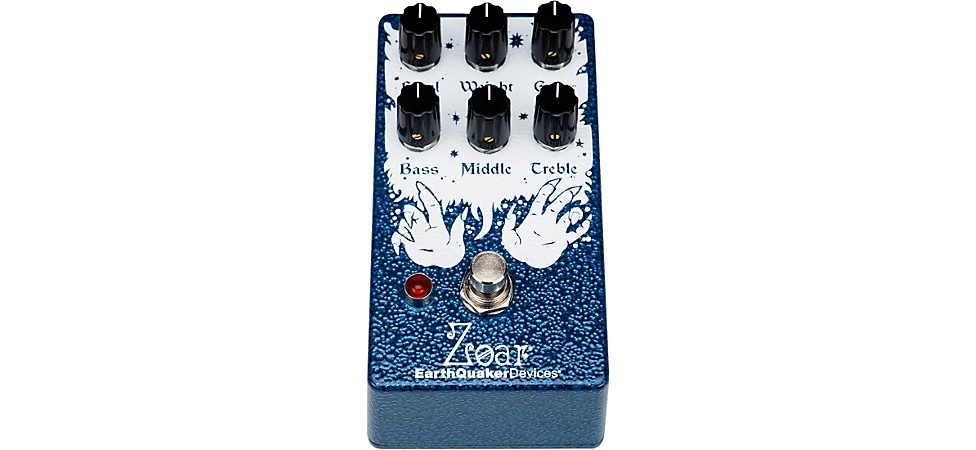
Shop Now: EarthQuaker Devices Zoar Dynamic Audio Grinder Distortion Pedal
The Zoar Dynamic Audio Grinder by EarthQuaker Devices covers a broad tonal spectrum, with various settings yielding sparkling, transparent overdriven sounds; woofy, blown-out fuzz; or tight, articulate saturation. Of the six onboard parameters, Weight plays a heavy role in defining the character of the distortion, controlling the overall amount of low end. Balancing the Weight and Gain settings ultimately determines whether the Zoar sounds like a distortion or a fuzz.
Its passive 3-band EQ is modeled after a classic Fender tone stack, modified to work within the Zoar’s circuit. Overlapping crossovers mean each band is highly interactive with the other, and a little bit of adjustment goes a long way. What’s more, you can power this pedal at higher voltages of up to 18V, which results in tighter lows and even greater articulation—plus, the Zoar distortion sounds phenomenal on bass.
Electro-Harmonix Hell Melter
What to Know:
-
Revives the notorious “buzzsaw” distortion of early Swedish death metal
-
An internally adjustable boost provides extra gain when you need it
-
Includes a power supply
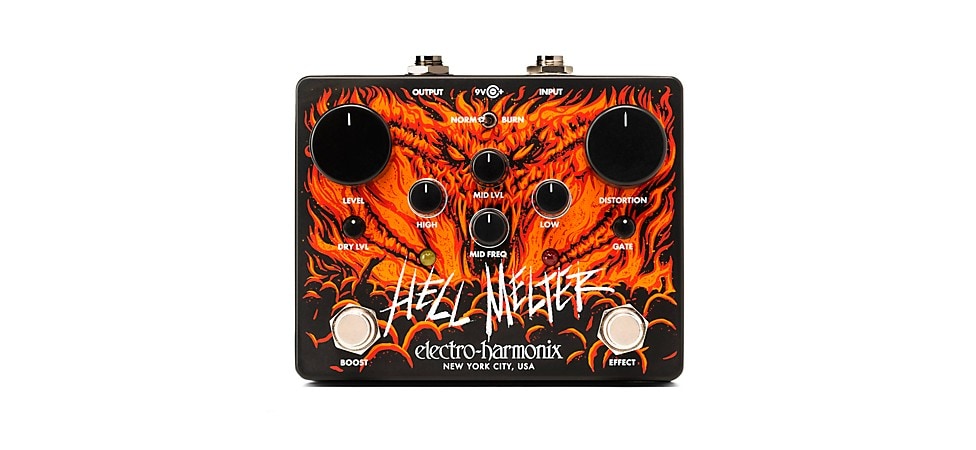
Shop Now: Electro-Harmonix Hell Melter Distortion Pedal
Alongside legendary producer Tomas Skogsberg, Sweden’s Entombed defined a genre with Left Hand Path in 1990, and the Electro-Harmonix Hell Melter distortion reinvents the symbolic HM-2 pedal for the modern era. In Burn mode, the Hell Melter boasts greater headroom, an open, less compressed sound and more precise attack, additionally utilizing an alternative clipping style. From a sonic standpoint, Normal mode returns players to the secluded woods where Swedish death metal was born.
An active 3-band EQ with a semi-parametric midrange lets you dial in (or out) that unmistakable buzzing grind, while a built-in noise gate keeps the signal clean. There’s even an extra gain stage at the beginning of the circuit that kicks on with the Boost footswitch, driving the pedal harder and varying its hard-clipping structure throughout. The EHX Hell Melter is a grisly standalone distortion, but it also plays friendly with other gain pedals thanks to an onboard wet/dry blend.
Fender Godzilla
What to Know:
-
Packs deep tone-shaping control and Godzilla-sized high-gain attitude
-
Active Treble and Bass EQ precisely shape low-end weight and top-end bite for rock and metal
-
Internal trim controls provide another layer of tonal refinement

Shop Now: Fender Godzilla Distortion Pedal
The Godzilla Distortion effects pedal takes Fender’s pedal platform and pushes it firmly into high-gain territory with a circuit that’s built to deliver saturated, modern distortion without getting muddy. The active Treble and Bass controls play a big role here, giving you more authority over both ends of your signal than the typical single-tone-knob setup, so you can tighten up low-end response or add bite without losing definition.
In use, it’s a pedal that rewards dialing in—small adjustments to the EQ and gain can shift it from thick, driving rhythm tones to more focused, cutting lead sounds. The internal trim controls add another layer for players who want to fine-tune how the pedal responds under the fingers, making it more adaptable than its straightforward layout might suggest. Paired with its distinctive Godzilla design, it brings a bit of personality to a category that often leans purely utilitarian, without losing sight of the core job: delivering heavy, usable distortion.
Fender Pugilist V2
What to Know:
-
A versatile choice for starting a pedalboard or expanding an existing one
-
Two distortion engines and three signal paths unlock a wealth of tones
-
Independent Gain, Tone and Level controls join a second footswitch for easy command of both circuits
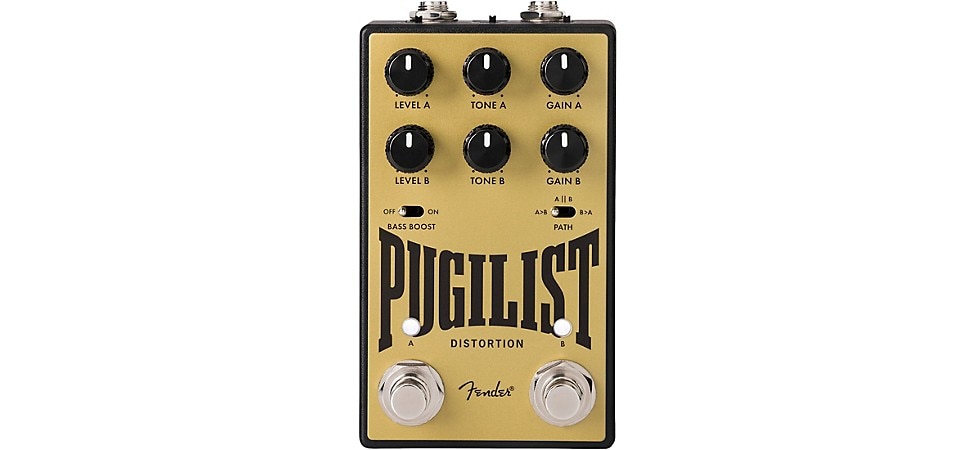
Shop Now: Fender Pugilist V2 Distortion Pedal
An extremely versatile stomp that covers the entire distortion spectrum—from saturated leads to thick, crushing chords—the Pugilist V2 is a veritable step up from the original. With the addition of a second footswitch, you can now control both distortion circuits with ease, giving you the ability to stack or dial back your gain throughout performances. The interaction between both distortion engines, and the bevy of routing options that its three signal paths provide, make this pedal a one-stop shop for players looking for a well-rounded distortion pedal with the potential for more complex tonal combinations.
JHS PackRat
What to Know:
-
Pays tribute to the influential RAT circuit with nine voices spanning nearly five decades
-
Digitally controlled switching provides access to fully analog distortion circuits
-
True-bypass operation preserves your signal when the pedal is off
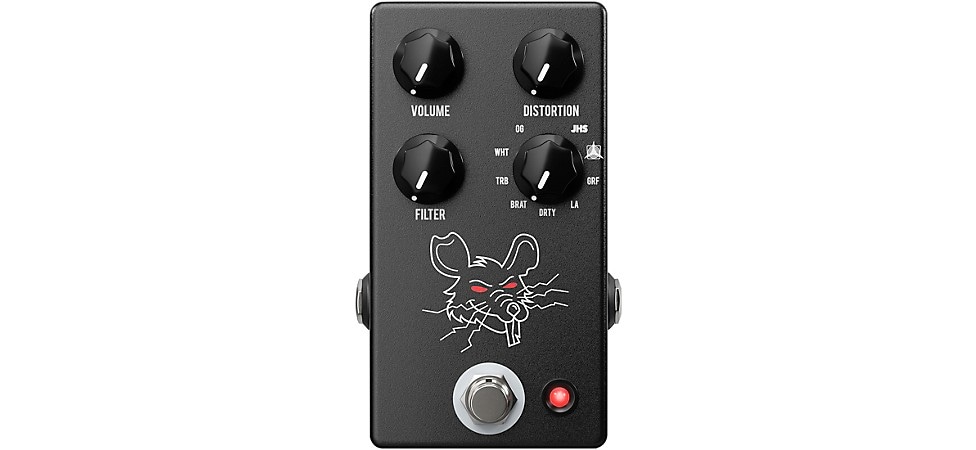
Shop Now: JHS Pedals PackRat Distortion Pedal
The JHS PackRat is a love letter to the renowned “rodent-style,” hard-clipping distortion pedal of the late ’70s and beyond. Joshua Heath Scott is a RAT connoisseur, having spent years researching, playing and modifying them, and his unique expertise informs the nine meticulously recreated tones housed in this pedal. The PackRat faithfully captures the fuzz-distortion sound of OG V1 models produced between 1979 and 1983, as well as V3, V5, V6 and V7 iterations from the mid-80s to the 2000s.
We’re not biased, but the BRAT (V6) mode is certainly one of our favorites. In 1996, ProCo inked a deal with Guitar Center to develop an exclusive, budget-friendly pedal, ultimately dubbed “Roadkill.” Its sound is profoundly ’90s grunge influenced and represents the greatest evolution of the circuit at that time. Shortly after, ProCo released the non-exclusive BRAT, with the same “guts” as the Roadkill, modeled here in the JHS PackRat.
Rounding out the rat’s nest are three modified RAT-style pedals JHS procured from other developers, including the Ibanez LA Metal from 1986, a 1999 Landgraff MO’D and a 2010 Caroline Wave Cannon. Last but not least, JHS Mode retains the true character of the original with a few of Scott’s favorite modifications.
Keeley Filaments
What to Know:
-
Layers three gain stages to recreate the sound and feel of a high-gain tube amp
-
Primarily aimed at metal players, with supply voltage influencing its tone and response
-
True-bypass operation keeps the dry signal untouched when disengaged
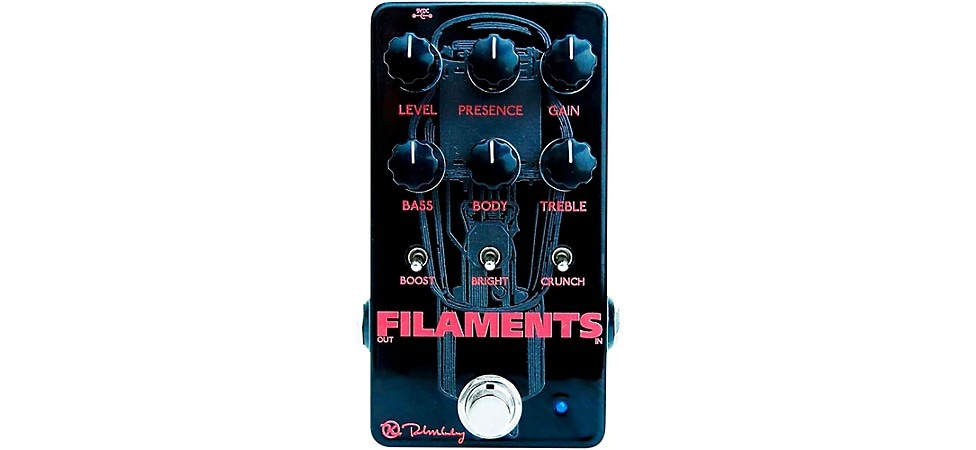
Shop Now: Keeley Filaments Distortion Pedal
The Keeley Filaments distortion pedal offers searing tone at practical volumes, comparable to the roar of a raging high-gain head. By stacking three gain stages and providing seven ways to EQ and fine-tune your sound, Filaments is armed to take on modern progressive metal, old-school thrash and virtually any style of aggressive music in between. If you’re mindful of its settings, it’s even possible to coax out overdriven crunch for blues, rock and other lower-gain stylings.
Bass and Body controls work together to shape the low-end response of the pedal, shoveling mud or beefing up an anemic tone. Boost and Crunch switches offer their own gain and compression levels, while a Bright switch opens up your guitar’s voice with a top-end push. Tweaking both Presence and Treble parameters lets you dial in just the right amount of bite and air, and they’re especially useful for down-tuned or extended-range instruments with a lot of natural low end.
Should you power the pedal with 12 or 18 volts instead of the standard 9V, you’ll notice an increase in overall volume and additional clean headroom—the latter is handy for making the gain sweep more gradual.
MXR EVH Modern High Gain
What to Know:
-
Originally developed with Eddie Van Halen, it delivers scorching, amp-like distortion for thick rhythms and searing leads
-
A 55Hz/80Hz bass-shift switch quickly adjusts the pedal’s low-end focus
-
Built-in boost and noise gate
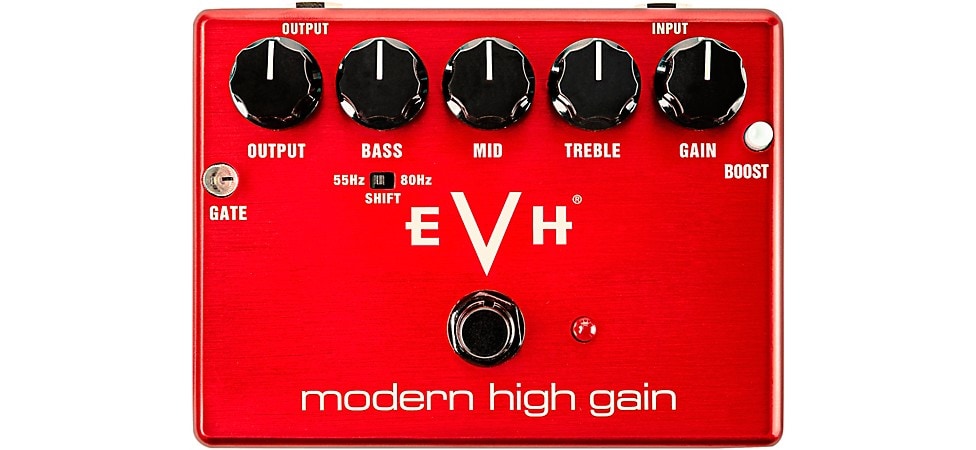
Shop Now: MXR EVH Modern High Gain Distortion Pedal
The MXR EVH Modern High Gain distortion pedal takes the raw power of Eddie Van Halen’s signature sound and funnels it into a stompbox ready to tackle everything from late-’70s hard rock crunch to modern-day djent and beyond. You can refine your sound as you would on an amplifier using its 3-band EQ, while adjusting the bass frequency focus switch lets you quickly select between beefier or punchier low end. A dedicated boost function shoots your solos into the stratosphere by applying additional volume to the input and final gain stage, and if you crave dimed-out saturation, just dial up the noise gate to clamp down on any hiss and hum that creeps in.
There’s nothing quite like the “purr” of a palm-muted, high-gain EVH riff, and this pedal easily gets you in that realm.
MXR M104 Distortion+
What to Know:
-
A late-’70s breakthrough built for no-frills, explosive saturation
-
Ultrasimple layout and germanium diode clipping make dialing in crunch or fuzz-like distortion easy
-
Runs on a 9V battery or 9V DC power supply (sold separately)
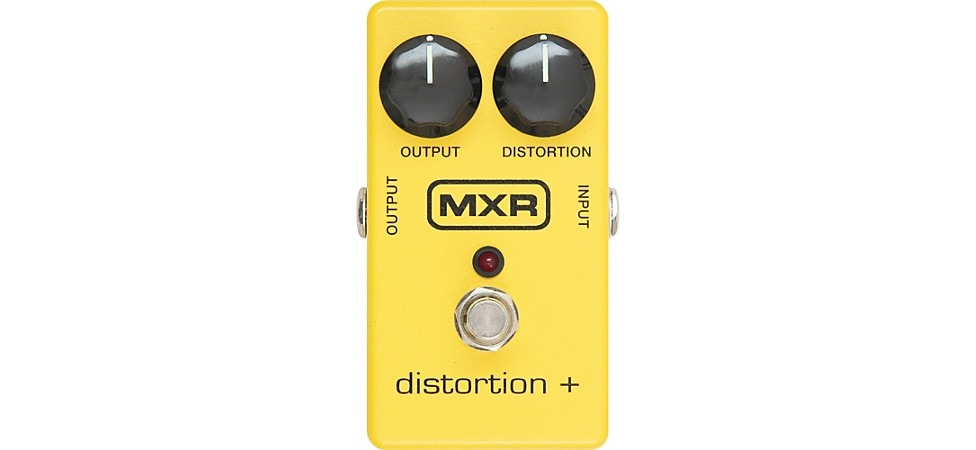
Shop Now: MXR M104 Distortion+ Pedal
Sometimes two parameters are all that’s required, and the MXR M104 Distortion+ proves it. Between volume and gain, the M104 covers a ton of ground—keep the Distortion knob low and dime the Output to work it like an overdrive, or dial up the madness for breakup that’s borderline fuzzy.
It’s lean, it’s mean and it’s a distortion pedal that can take you from bluesy crunch to massive ’80s-tinged hard rock in zero seconds flat. The MXR Distortion+ has been serving deliciously destroyed tones for players of all stripes since 1977.
ProCo RAT2
What to Know:
-
A celebrated, widely imitated distortion circuit prized for its versatility and ease of use
-
Fully analog signal path inside an exceptionally durable steel enclosure
-
Sloped face makes stomping easy, while the no-tools battery compartment simplifies 9V power changes
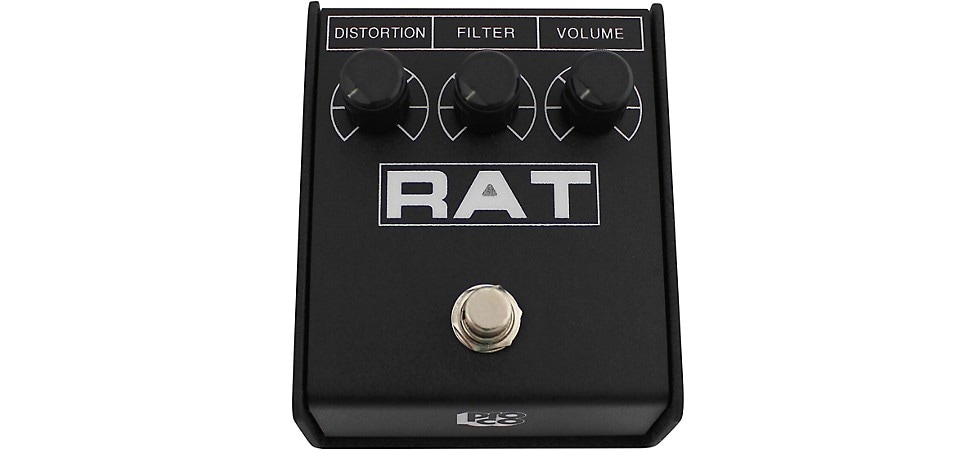
Shop Now: ProCo RAT2 Distortion Pedal
The ProCo RAT2 is the current iteration of a classic that’s widely considered the gold standard in distortion pedals. Three streamlined controls—Distortion, Filter (of the low-pass variety) and Volume—open up worlds of saturated goodness. None of us would be the first to note just how impressively versatile the RAT is, housing everything from mid-hyped overdrive to tube-style distortion and square-wave fuzz in its virtually indestructible enclosure.
In the world of effects pedals, “iconic” is an apt descriptor for the ProCo RAT. It’s truly a special distortion pedal used on thousands of recordings by a who’s-who of music’s most influential artists. You can’t go wrong with a RAT—check out our complete guide to the ProCo pedal that’s left an indelible mark on guitar history.
Wampler Phenom
What to Know:
-
Channels “5150”-style tones through smooth, responsive distortion
-
JFET-based clipping delivers amp-like touch sensitivity while retaining playing dynamics
-
Its tone and response change depending on the power supply voltage
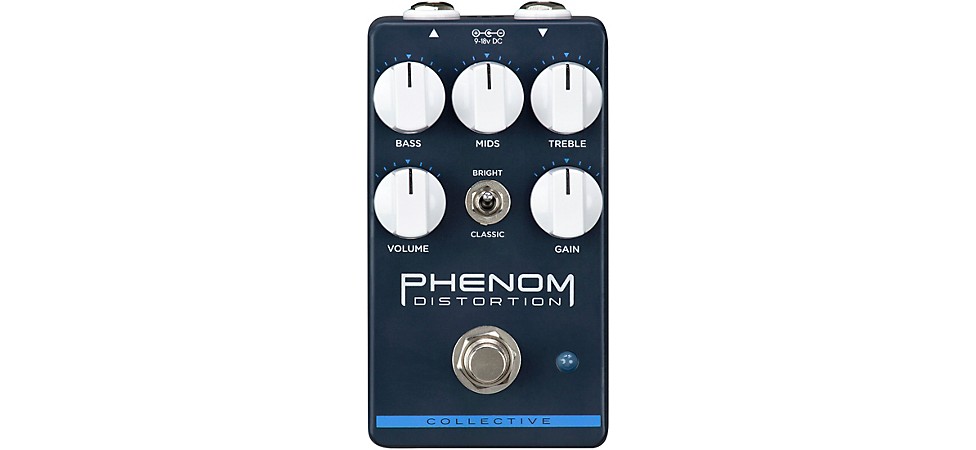
Shop Now: Wampler Phenom Distortion Pedal
The Wampler Phenom Distortion is part of the Collective Series, offering guitarists on any budget high-quality, affordable pedals without compromise. Loosely based on legendary “5150” sounds, the dual-voiced Phenom features a Classic mode with liquid breakup and punchy lows, and a Bright mode with extra bite and aggression for cutting leads or searing riffs.
Its ingenious JFET circuit, designed by Brian Wampler, drives to saturation similarly to a tube amplifier, meaning this pedal sounds and feels a lot like the real thing. Single coils and humbuckers retain their unique characteristics and aren’t washed out by over-the-top solid-state distortion, and the pedal responds to playing dynamics, like how gently or aggressively you dig in.
Get Down and Dirty With a New Distortion Pedal
Distortion is an inherent part of the electric guitar’s sound. From the early rock days of pushing small tube amps into organic saturation to the evolution of high-gain metal—and the gear that makes it happen—distortion is a pivotal effect that’s helped define genres for decades. We’ve covered a handful of the best distortion pedals in 2025, but feel free to browse Guitar Center’s extensive used selection to find killer deals on the drive of your dreams.
Want to hear them in action? Stop by your local Guitar Center and visit the pedal table to sample a range of effects up close.
Written By: Max McAllister
Max McAllister is an audio engineer, guitarist and writer. At the Brewery Recording Studio, he earned engineering credits on Kid Cudi’s Man on the Moon III, Duckwrth’s SuperGood and the LeBron James Space Jam compilation, among others. Max previously wrote for Produce Like A Pro, where he authored over 600 articles, and has also contributed to Adorama’s 42West. He’s proudly served Guitar Center as a senior writer since 2023.
Recently Added to Buying Guides

Be the first to know about exclusive offers, tips and more.

866-498-7882 English
877-687-5402 Español